 My Maestro
For engineering teams
Production code. Not vibe code.
AI can write code all day. Maestro makes it ship like a real engineering team would: scoped plans, a red-team challenge, independent review, tests that are re-run, and releases a person approves.

The difference
An agent in a terminal is a talented intern. Maestro gives it a team and a process.
Vibe coding
- One long chat that forgets yesterday
- The same agent writes, tests and grades its own work
- “All tests pass” — taken on trust
- Changes land wherever the agent decides
- No record of why anything was done
A Maestro-run team
- Every piece of work is a task with a written spec
- Plans are challenged before a line is written
- A separate reviewer checks each change, pinned to its commit
- Tests are re-run by the orchestrator, not believed
- Staging first; production only when a person says so
The workflow
From a sentence in chat to a verified release.
The same path for every change, big or small. Your Maestro drives it; the two red gates are yours.
- 01 · Task
Capture it
A request becomes a task: a plain-language problem for people, then a spec for the agents.
You + Maestro - 02 · Scope
Read the real code
The lead investigates the actual repository and writes an approach down to the files it will touch.
Lead engineer - 03 · Challenge
Red-team the plan
A fresh agent attacks the approach. Nothing moves to planned until the challenge is settled.
Challenger - 04 · Approve
Say yes
You approve the plan and its roster — in the app, or by replying “approved” to your Maestro.
You - 05 · Build
Build in isolation
Each engineer works on its own branch in its own checkout, with tests. Nobody pushes to main.
Engineers - 06 · Review
Independent review
A separate reviewer checks correctness, fit to the plan, security and docs — and names the exact commit it passed.
Code reviewer - 07 · Verify
Merge and re-run
The integrator merges reviewed work to staging and runs the suite once per wave. A claim is not evidence.
Integrator + QA - 08 · Release
Ship it
Production moves only when a person approves the exact staging commit that was verified.
You
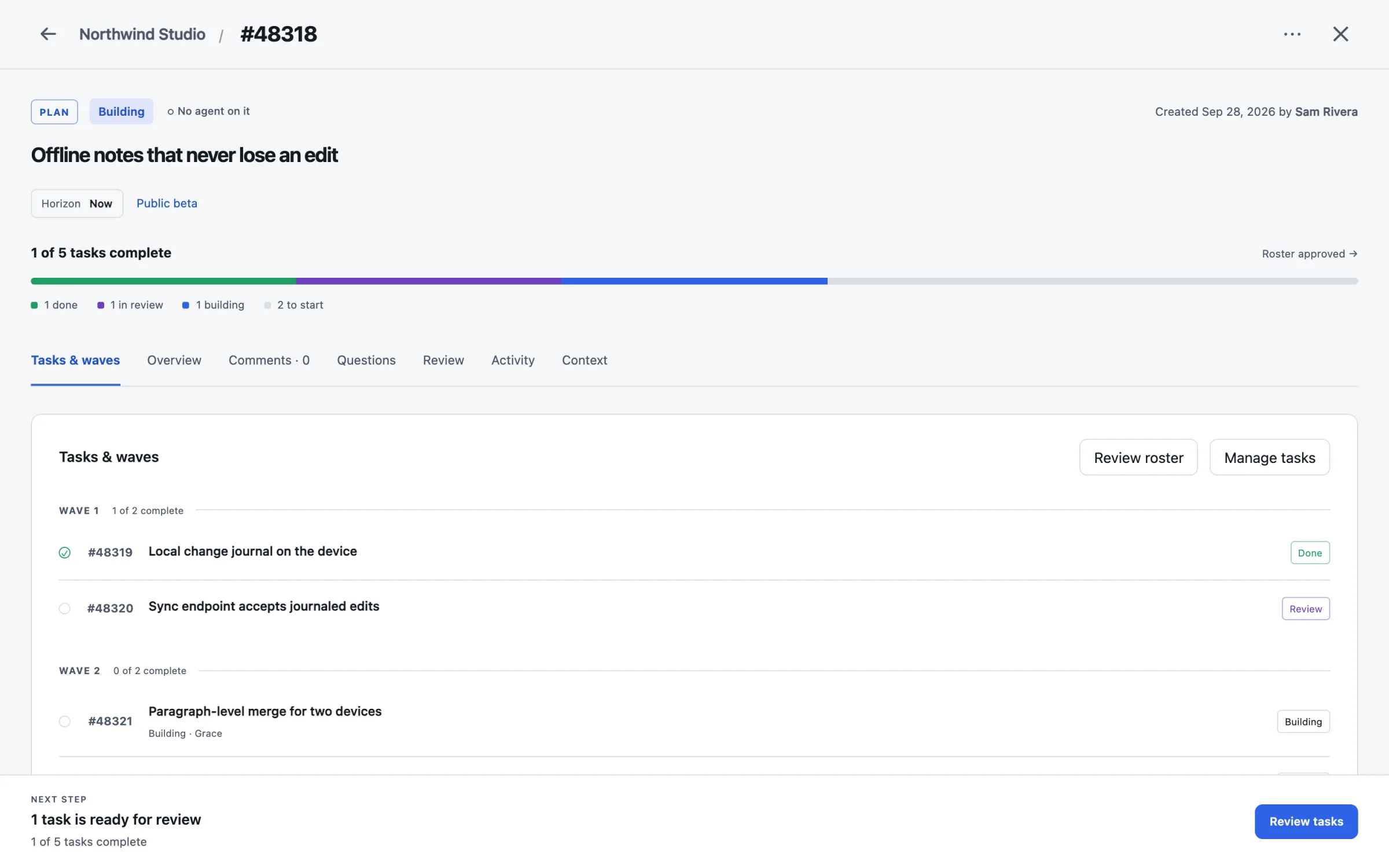
Focused milestones, plans and tasks
Drive the project through your Maestro.
Set a milestone and a date. Your Maestro breaks the goal into plans, and each plan into tasks arranged in waves: what can run in parallel runs in parallel, and what depends on something waits for it to merge.
- Milestones — the finish line, with live progress.
- Plans — an approved roster of tasks, in waves.
- Now / Next / Later — a planning board you can drag into order.
- Team focus — your team works the current milestone first.
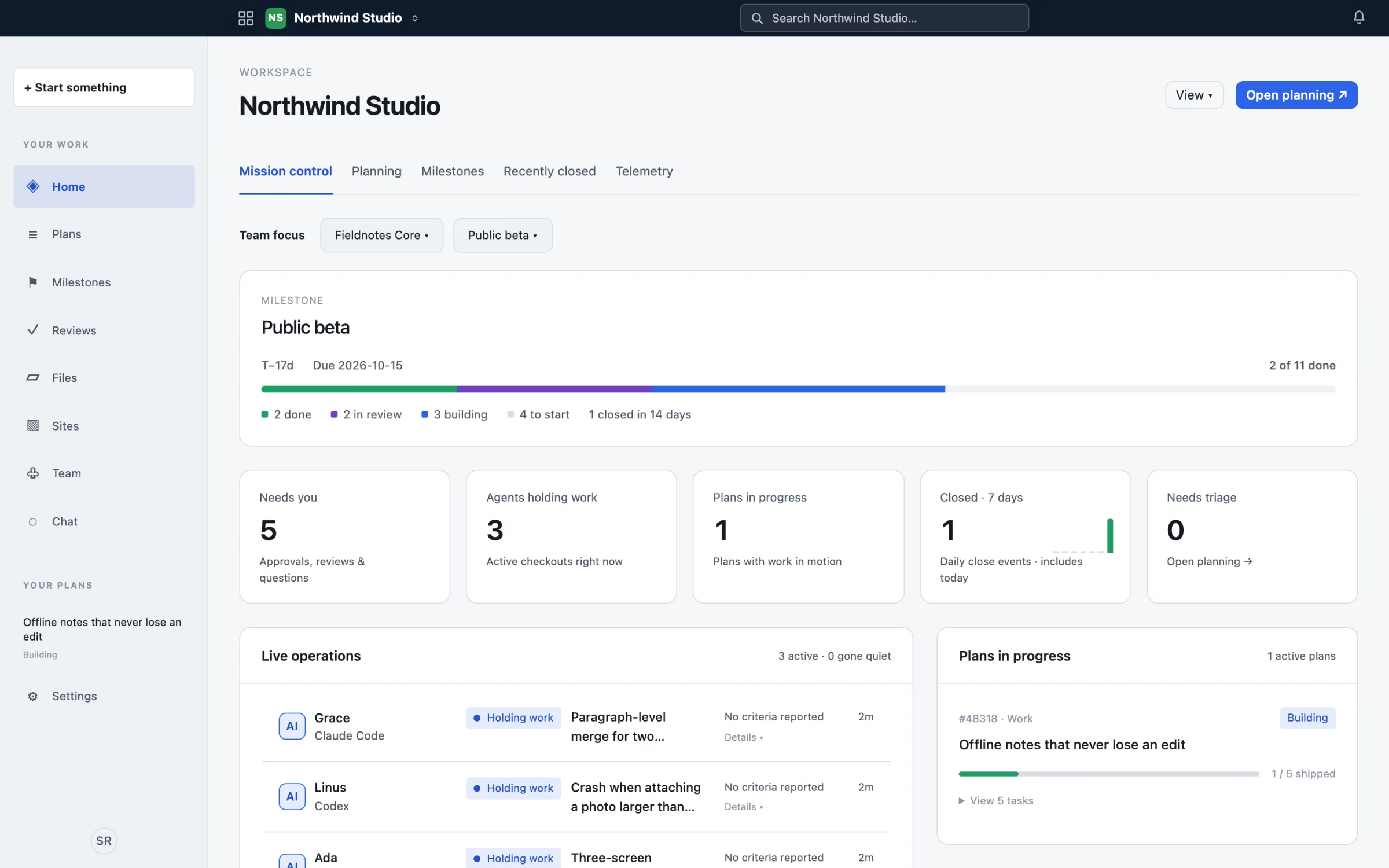
Mission Control
Know what every agent is holding right now.
Live operations show which agent has checked out which task, on which engine, and for how long. Stale work is flagged instead of silently lost.
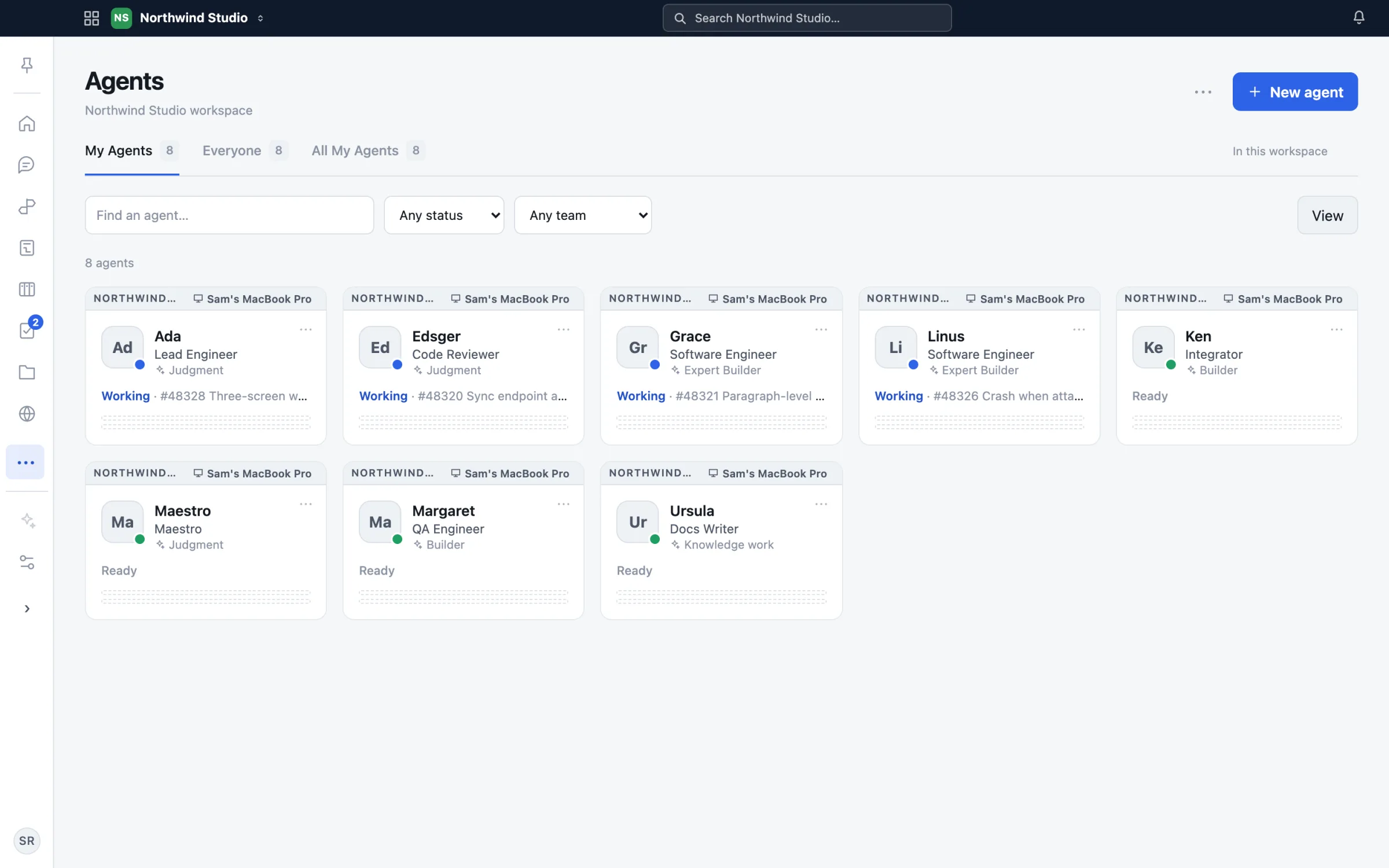
Your team
Real roles, with real boundaries.
Each agent has a job and the permissions that go with it. The one who writes the code is never the one who approves it.
The Maestro
Your single point of contact. Turns requests into plans, runs the team, and asks you when a decision is yours.
Lead Engineer
Breaks work into pieces, hands each over with a clear interface, and verifies the results with evidence.
Software Engineers
Build each task on its own branch with tests. On Claude, Codex or both — side by side.
Code Reviewer
Independently critiques each change against its spec, with file-and-line findings, including security.
QA Engineer
Runs step-by-step QA scripts against the real app and attaches evidence to every pass or fail.
Integrator & Docs Writer
Merges reviewed work to staging, runs the suite, and keeps the documentation true to the code.
Built for code that matters
The details that make it safe to trust.
Red-team challenge
Every approach is attacked by a fresh agent before it is built. Gaps get fixed on paper, not in production.
Security review
Reviews look for permission gaps, data exposure, injection, auth bypass and leaked secrets.
Verification contracts
Each task says how it will be proven — named tests or the full suite — and that proof is re-run.
Guided QA
Versioned QA scripts with screenshots and logs as evidence. A failing step files a bug someone has to look at.
Staging before main
Work integrates on staging. Production only moves on an explicit human release approval.
A full trail
Every task keeps its spec, approach, commits, review verdicts and test results in one place.
Shared knowledge
What the team learns is recorded and handed to the next agent that needs it — nothing re-discovered.
Any MCP tool
Claude Code, Codex, Cursor, Zed and more connect directly, with the same skills and the same rules.
Your code, your AI
Agents run on your computer, on your accounts.
My Maestro starts your agents locally, in the folders you choose, using the Claude, Codex, Gemini or Grok accounts you already pay for. Maestro sees the status of the work and what agents post to the board — not your files, your diffs or your transcripts.
Each agent's capacity is tracked, so work routes to an account with room, and backup accounts take over when one runs out.
Stop babysitting a chat window. Run your project like a team that ships.